Tuesday, September 27, 2011

Cylindrocladium blight

Cylindrocladium blight is a disease caused by a plant pathogenic fungus.  Infection results in leaf spots, brown, dead stems, and often dead plants.  On blueberry it is a disease of propagation and nursery beds, and is rarely seen on plants in the field. Symptoms commonly appear in blueberry rooting beds in the late summer and into fall. The disease may also occur in potted plants that are spaced too close together in pot yards.  One species of this particular fungus also infects peanut plants in the field, so blueberry propagators in North Carolina often call the disease "peanut blight".  There are many species of Cylindrocladium that infect plants, and there may be more than one species of this fungus causing disease in blueberry rooting beds.  At present the only species reported on blueberry in North Carolina is now considered to be Cylindrocladium parasiticum, hence the common name of the disease, Cylindrocladium blight.

Cylindrocladium blight in a bed of softwood cuttings in late fall.

Closeup of orange fungal fruiting bodies on an infected cutting

Irregular-shaped spots on lower leaves of older rooted cuttings

The disease is most often seen in propagation beds and pot yards that have grown vigorously and are too dense to allow proper air movement between plants.  Spores of the fungus infect leaves and stems, and eventually kill entire plants.  Often the root system is the last healthy part remaining.  The phenomenon of plants dying in the center of a dense block, while those at the edge (with better air circulation) survive, is characteristic of this disease in dense beds of plants.
 

Large area of dead plants in a propagation bed late in the season

In pot yards and late-stage propagation beds where the plants have already formed roots, this disease is best managed by not over-watering or over-fertilizing plants, and by maintaining proper plant spacing so that the leaves and stems can dry between waterings.  Cull to remove and discard any dead plants, and space the remaining plants out as much as possible so that there is good air movement between the bushes.  Do not re-use any old used potting media, as this disease can carry over from one year to the next in contaminated soil or potting mix.  Clean up as much debris as possible and sanitize the bed area and any pots that you plan to re-use.

Tuesday, August 23, 2011

Blueberry Stem Canker

Blueberry stem canker caused by the fungus Botryosphaeria corticis is common on cultivated and wild blueberries in North Carolina.  The disease spreads by spores and through the use of infected cutting wood for propagation.  Canker is important because it can weaken and kill susceptible or stressed bushes.

'O'Neal'  canes dying out due to canker infections


Symptoms: Cankers are noticeably thicker than adjacent portions of the stem, forming raised areas with deep cracks.  Usually only short sections of the stem are affected, though canes of some very susceptible cultivars can have multiple infection points along their entire length.


Swollen area (at center) with deep cracks is a fully developed canker

Disease cycle:  Infection of stems is by spores (ascospores and conidia) that are released during wet weather and disseminated by wind from April through September.  Young, succulent, actively growing shoots are infected, and symptoms appear within 4 to 6 months after infection.  As the fungus continues to grow and invade the wood, large cankers with deep fissures and cracks develop that girdle, weaken and kill the stem.

Cankers on a young stem, exuding spores


Control:  Fungicides are partially effective but not practical. Control relies on maintaining general plant health,
pruning to remove canker-weakened canes,use of resistant cultivars, and use of disease-free planting stock.  Cutting wood should be selected from undiseased plants, or the plants sourced from disease-free nurseries.  In areas where canker is not present, the use of disease-free planting stock is critical to avoid introducing this pathogen to an new field.

Highbush blueberry:  Among the popular southern highbush cultivars (Vaccinium corymbosum) grown in eastern NC, O'Neal, Blueridge and Legacy are susceptible -- however all three are successfully grown where plant health is maintained via proper site selection, fertility, pruning and irrigation.

Cankers on a one-year-old 'Legacy' stem

Rabbiteye blueberry: Cankers can be numerous on rabbiteye blueberries (Vaccinium virgatum, synonym V. ashei) but generally do not cause yield loss on this vigorous blueberry species.

Monday, August 22, 2011

Collecting softwood cuttings

As discussed in a previous post, blueberries can be easily propagated in summer from leafy softwood cuttings by using an intermittent mist system to keep the cuttings from drying out during the six- to eight-week rooting period.  However, a specific stage of shoot growth must be selected for cuttings, because not all leafy shoots will root -- those that are too old will tend to form flower buds rather than roots, and cuttings from shoots that are too young and succulent will wilt before rooting can occur. The photos below illustrate when and how to collect and stick softwood cuttings.

Timing:  Collect cuttings when shoots are 10-12 inches long and semi-hardened.  In southeastern NC,  this occurs in late May and again in late July or early August:

Blueberry bush in early August with suitable shoots for propagation


Cuttings can be snapped off by hand or clipped with pruning shears

Pinch off the top of the cutting and remove the lower leaves


Age of cuttings:  Select cuttings with leaves that are intermediate in color between the darkest older leaves and the palest young shoots.  Softwood cuttings should be immature but not succulent.  Cuttings that snap easily when bent are too young -- the cuttings should be bendable and becoming woody.

Leafy shoots from oldest to youngest.  The two in the center are suitable for propagation.
Softwood cuttings of the proper stage are bendable but do not snap

Shoots that snap easily when bent are too succulent for outdoor propagation beds

Handling:  Collect cuttings early in the morning if possible, to minimize wilting.  Once collected, cuttings are susceptible to wilting and must be kept moist and cool. Sprinkle with water and store in a cooler with ice until ready to stick the cuttings in the rooting bed.  Caution -- direct contact with too much ice can damage cuttings -- keep them cool but not icy.


Take a cooler and water to the field to keep cuttings from wilting

Sticking cuttings:  Cuttings are stuck into six- to eight-inch deep rooting beds filled with aged milled pine bark. Stick the cuttings 1.5 to 2 inches apart in rows by cultivar.  Approximately half the length of the cutting should be in the bark, with only the leafy section above the bark. The mist system should be running during this process so that the cuttings are never allowed to dry out.

A measuring stick is used to space the cuttings evenly across the bed.

Cuttings are stuck approximately half their lengh in the bark

A commercial rooting bed partially filled with cuttings

Cuttings typically root within six to eight weeks.  Once fully dormant, the cuttings can be dug and either potted, or planted directly into the field.  Most nurseries and commercial growers pot rooted cuttings and grow them out for a year prior to selling or setting in the field.

For further reading: 
Krewer, G. K. and W. O.Cline. 2003. Blueberry Propagation Suggestions.
Bilderback, T. E., R. E. Bir and M. A. Powell 1993.
A Simple Intermittent Mist System for Propagation.

Wednesday, August 3, 2011

Blueberry cultivar 'LEGACY'

Released: 1993 (not patented)

Developed by: USDA and NJAES, Rutgers University

Selection number: G-290

Parentage: 'Elizabeth' x US75 (Vaccinium darrowi,'Florida 4B', x 'Bluecrop')


Species/Type: Vaccinium corymbosum (southern highbush)

Bloom date: April 1 in southeastern NC (approx 1 wk before 'Croatan')


Harvest season: First harvest around May 30 - June 3 in southeastern NC

Chill requirement: Estimated to be 700 to 800 hours below 45F

Description: Upright, open habit with flexible canes. Highly vigorous, forming an abundance of flower buds on both longer canes and lateral fruiting twigs.  Often a few leaves from the previous season will overwinter, persisting until after bloom the following spring. Early-blooming with pure white,elongate flowers.  Fruit light blue, firm, with excellent flavor; large berries becoming medium in size with successive harvests, small dry stem scar.  Clusters are open and well suited to mechanical harvest.  Berries maintain their quality even when slightly overripe, and are less prone to decay than other highbush cultivars.


Good Characteristics:  Blooms exhibit cold hardiness during spring freezes. 'Legacy' is highly productive with high-quality fruit that can be hand- or machine-harvested for the fresh market.  Widely adapted to different soil types, 'Legacy' is a good candidate for highbush production on pine-bark-amended soils in the piedmont.


Flaws:  Early blooming may result in yield loss due to spring freezes.  'Legacy' ripens two to three weeks later than early cultivars like 'Star' and 'O'Neal'. 'Legacy' is susceptible to blueberry stem canker disease caused by the fungus Botryosphaeria corticis, and will require irrigation and selective pruning to manage this disease.  Purchase of disease-free propagation stock will reduce or delay the effects of stem canker.

Potential:  Rapidly becoming a leading cultivar in North Carolina due to high yields and excellent fruit quality, 'Legacy' is recommended for commercial planting on lowland blueberry soils in southeastern NC, and for trial plantings in amended upland soils in the coastal plain and piedmont.


Tuesday, August 2, 2011

Wind burn

Wind burn occurs when high winds coincide with the emergence of new, succulent leaf shoots.  The symptoms can be mistaken for insect injury, disease, drought or chemical injury.  Characteristics of wind burn are new shoots that first appear scorched and wilted, then become dried, dead and shriveled.  Older leaves with wind damage have necrotic areas and cracks at the leaf margins.  Symptoms appear immediately on new shoots in high winds.  The first photo below was taken on the day that injury occurred, while the wind was still blowing.  The second photo shows what the injury looked like one month later.

Browning of new shoots can occur very rapidly on a windy day


Wind burn one month after the injury occurred

Friday, July 29, 2011

Exobasidium fruit and leaf spot

Symptoms caused by the fungus Exobasidium vaccinii have occurred sporadically in individual fields for years, but have not posed an industry-wide threat to blueberry production in North Carolina.  However, in 2011 we saw increased incidence of this disease, and symptoms on previously unaffected cultivars such as Legacy and Columbus.  The fungus causes spots on both leaves and berries. Spots on fruit are especially problematic because it is impossible for pickers to avoid harvesting affected berries, and nearly impossible for color-sorters and packing-line inspectors to remove them during the sorting and packing process.

Green spots caused by Exobasidium on 'Legacy', 1 June 2011

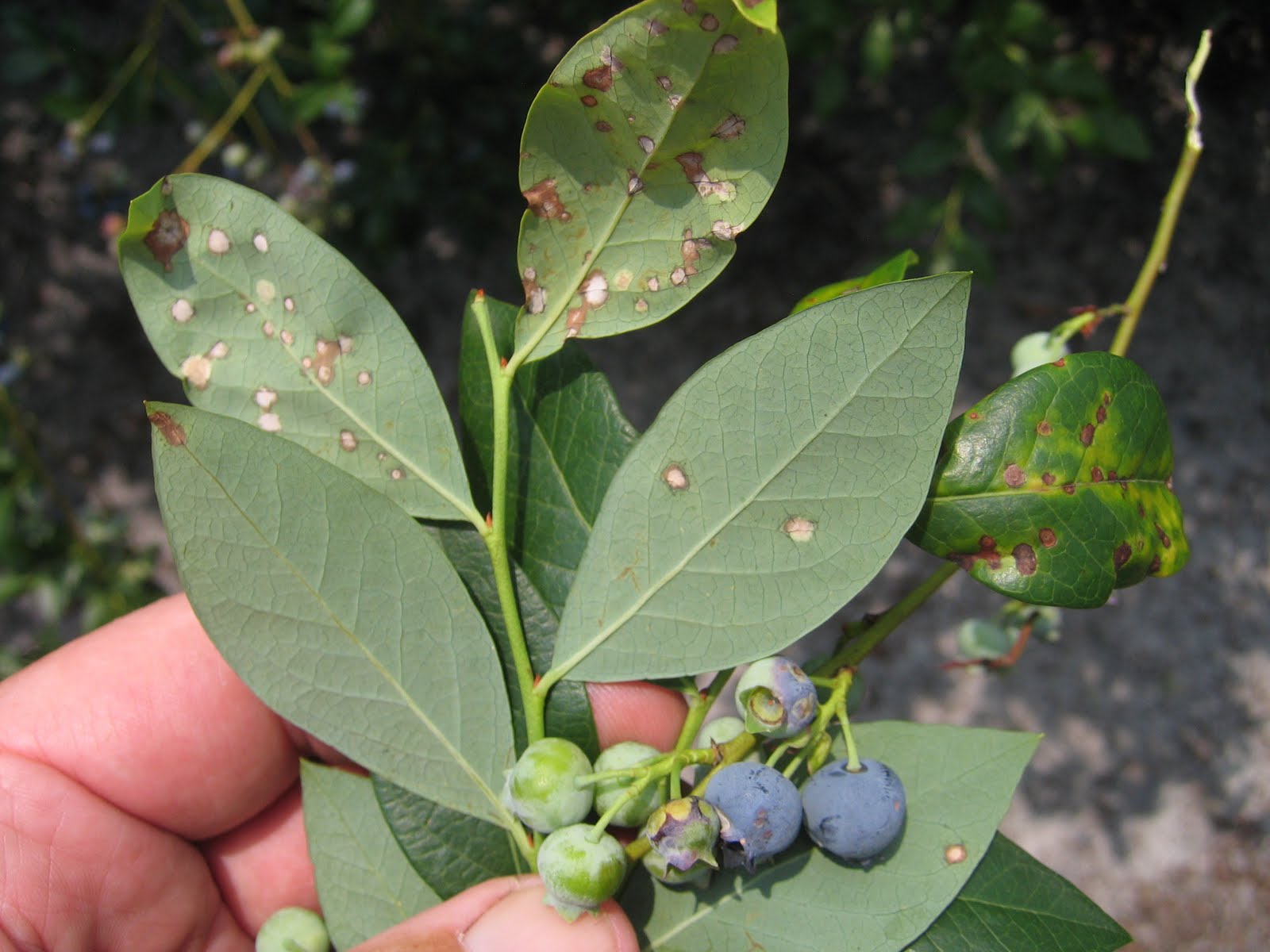
On berries, infection produces a green spot that fails to ripen normally. Affected berries do not leak or decay, but the green spot on an otherwise uniformly ripe berry is an unsightly defect that could lead buyers to reject the fruit when delivered.  On leaves, spots are pale green on the upper surface but pure white below, with a thin, dense layer of fungal growth on the underside of the leaf.  This fungal growth is most obvious on the underside of leaves, but can also occur on infected berries. 


Exobasidium leaf spot -- upper surface

Exobasidium leaf spot -- underside of leaves showing fungal growth

As spots on leaves age, they become brown and necrotic, although the white fungal layer is often still visible on the underside of the leaf.


Exobasidium on 'Legacy' leaves and fruit 7 Jun 2011

Eventually, the unique symptoms fade and the spots become indistinguishable from many other leaf-infecting fungi.

Symptoms on 'Legacy' upper leaf surface 20 Jul 2011

Symptoms on the lower leaf surface 20 Jul 2011


The fungus produces spores on both leaves and berries. As shown below, they are often a distinctive 'musiform' or banana shape, may be divided (septate), and measure roughly 4.0 to 5.2 μm wide × 13 to 15 μm in length.
Drawing of characteristic spores as seen under a microscope

 Little is known about the life cycle of this fungus on blueberry.  Infections appear in the spring on developing leaves and berries, but the fungus does not appear to infect later flushes of leaf growth.  Lesions have not been observed on other plant parts (stems, buds) and it is not known how this pathogen overwinters.  Visually, infections appear to be localized, distinct and limited to the affected berry or leaf, rather than systemic in the plant.  Since blueberries drop their leaves each winter,  there may be some quiescent infection stage on or in the remaining, bare dormant stems or buds that serves as the overwintering mechanism.

Fungicides have been shown to be at least partially effective in controlling this disease.  A study by David Ingram and John Braswell at Mississippi State University achieved measurable control on rabbiteye blueberries.  The combination of pyraclostrobin + boscalid (Pristine) was most effective in their tests.


Infections on the rabbiteye cultivar Premier, 13 Jun 2008

Why is this disease becoming more prevalent?  It may be due to changes in the cultivars we grow, the loss of key fungicides in recent years, or to changes in cultural practices such as the increased use of irrigation.  If you are experiencing problems with this disease, I would like to know about it.  It appears to be an emerging problem not only in North Carolina, but in other southern states as well.  The more we know about it, the sooner we will learn to manage it -- thanks for your help!

REFERENCES:
W.O. Cline, 1998. An Exobasidium disease of fruit and leaves of highbush blueberry.

Thursday, July 21, 2011

Leaf Disease Symptoms

Leaf spot diseases caused by fungi are apparent in some fields this week.  Septoria leaf spot is a disease caused by the fungus Septoria albopunctata.  Infection results in small circular spots with dead gray centers. Often fungal fruiting bodies are visible as tiny black specks in the dead gray area at the center of each spot, as in the photo below. Spots first appear on oldest leaves near the ground. The cultivar Star is very susceptible

Septoria leaf spot on 'Star'


Another leaf symptom that is evident this week (21jul2011) is premature drop of yellowing older leaves.  The cause is unknown but is suspected to be a form of blueberry leaf rust.  Rust fungi cause yellowing and premature drop of leaves, and a characteristic symptom is the appearance of green spots on otherwise yellow leaves, consistent with the image below.  This symptom is especially noticeable on the southern highbush cultivar Legacy and on the rabbiteye Premier.  Rust diseases get their name from the appearance of orange spore masses on the underside of infected leaves, but so far we have not seen spore production on these yellowed leaves.  When viewed from the underside of the leaf, the symptoms resemble edema, so there may be some environmental stress, perhaps related to the drought, that is causing or contributing to the problem.


Yellowing and premature drop of 'Legacy' leaves on 20 Jul 2011

Leaf drop is a serious problem because it can severely reduce yield for the coming year. Twigs that defoliate prematurely will not set flower buds, and so will not bear fruit the following year.  There are several fungicides that can be used to control leaf diseases;  also, summer pruning immediately after harvest removes old infected leaves and forces clean new growth, greatly reducing the effects of leaf diseases.